Download this assignment as a Microsoft Word doc.
Important notes
- This assignment has several parts and deadlines. Taken collectively, its pieces represent the largest portion (40%) of your course grade. Please read it carefully.
- Although this is a large project with many pieces, we’ll be dealing with it in small chunks throughout the semester. Dr. Madsen will provide guidance on how to find all the information and images you need to complete the project. Students will receive plenty of support. Do not panic.
Assignment
This assignment calls on you to identify one historical upstander in the U.S. or its predecessor territories, research their life, and highlight their accomplishments. You will justify your designation of this person as an upstander. Finally, you will have an opportunity to reflect on your own potential as an upstander.
The assignment constitutes a service-learning opportunity in partnership with the Wassmuth Center for Human Rights, which runs the Anne Frank Human Rights Memorial and several educational initiatives for K-12 students and adults. If your research and writing is of sufficiently high quality, the Wassmuth Center staff might use it to create posters to be displayed in the memorial’s outdoor classroom, as well as other educational materials for teachers—and you will receive attribution on any such materials (a nice addition to your résumé!).
This assignment has four main pieces: a biographical essay with images, a justification, a reflection, and a very brief presentation.
Biographical essay and images (15% of course grade)
Write a 200-word, highly polished biographical essay that introduces an historical upstander in the U.S. and focuses on their most admirable work as an upstander. This person’s upstanding should have taken place before 1900, and ideally within the time under consideration by this course—from shortly before European colonization until 1877. (Note: Each student must have a unique upstander. Claim your selected figure in the “Upstander Selection” sheet in the course folder in Google Drive.
Imagine your reader is a high school student visiting the Idaho Anne Frank Human Rights Memorial. Adopt an engaging, accessible voice and pique their interest with your essay’s content.
Between your essay’s title and its body, include a distinctive, attention-getting quote from your upstander. After the end of your essay, please include the phrase “published under a Creative Commons attribution license” or “CC-BY” so that the Wassmuth Center may display your work, or portions of it, in the Anne Frank Human Rights Memorial classroom and in other educational materials.
Your essay should draw upon and cite both primary and secondary sources. Use the Chicago Manual of Style format for your citations.
You also need to find at least three images that are relevant to your essay. For example, you might include a portrait of the figure; an image of a particularly provocative newspaper headline or advertisement; or a photo, drawing, or painting of something or someone else important to that person. For example, Harriet Tubman’s biographical essay might be accompanied by a photographic portrait of her, an advertisement offering a reward for a fugitive slave, and a photo of a mid-19th-century boat on the Combahee River (where she helped plan a Union Army raid that liberated 750 slaves).
The images you submit must be openly licensed. We will talk in class about what this means.
Justification (10% of course grade)
Write a two-page, double-spaced essay that uses the class’s criteria for upstanders to justify why you believe your historical figure qualifies as an upstander. You may refer to some of the same accomplishments you you highlighted in your biographical essay, but do not plagiarize from that essay.
Again, cite your sources using the Chicago Manual of Style format.
At the bottom of the last page of your essay, please include the phrase “published under a Creative Commons attribution license” or “CC-BY” so that the Wassmuth Center may use your work, or portions of it, in the Anne Frank Human Rights Memorial classroom and in other educational materials.
If you wish, you may negotiate with Dr. Madsen to submit this portion of the assignment in a different format (e.g., infographic, audio, video). You must have a conversation with her and secure her approval of your alternate format.
Reflection (10% of course grade)
Write a two- to three-page, double-spaced essay in which you reflect on a situation in which you might decide to be an upstander. This essay should:
- Name at least one of your deeply held values, explain how you came to hold that value, and describe a very specific situation in which you imagine you might step up.
- Consider the risks and rewards of standing up in this situation.
- Summarize a pre-1877 precedent when someone stood up in a similar situation, and explain what the repercussions were for them and for the people for whom they were standing up.
- Explain why you are willing to take the risks you have identified in your imagined future situation.
If you wish, you may negotiate with Dr. Madsen to submit this portion of the assignment in a different format (e.g., infographic, audio, video). You must have a conversation with her and secure her approval of your alternate format.
Presentation (5% of course grade)
Introduce your upstander to the class in no more than three minutes. Your presentation should include your upstander’s name, birth and death years (or an approximation if those aren’t known), where they lived, what they did that you find most admirable, and how they meet the class’s criteria for upstanders.
This is an informal presentation, but it should be well-organized. Visual aids are not required, but if you wish, you may send Dr. Madsen an image, a very short PowerPoint presentation, or link to a very short Google slide deck so that she may queue it up on your presentation day.
Deadlines
- You will have an opportunity to sign up for a designated day for your three-minute presentation. Presentations will take place in class between November 5 and December 12.
- All of your work must be submitted as described below by noon (MST) on Tuesday, December 17.
Submitting your work
1. In your student folder in Google Drive, create a new folder for your assignment. This new folder’s name should follow this pattern: Your last name – upstander’s first and last names (for example, Madsen – Harriet Tubman).
2. Your assignment folder should contain the following documents:
a. The biographical essay for your upstander. (Format: Google doc)
b. At least three openly-licensed images relevant to your upstander or their historical moment. Give these images descriptive names. For example: Tubman seated circa 1868.jpg. (Acceptable image formats: .jpg, .png)
A list of image names, citations for each image, a link to where you found the image, and licensing info. (Format: Google doc)
List each image’s name, then place its citation and licensing info under it. Use the citation instructions found at the Library of Congress. For example:
Photographer unknown. “Harriet Tubman.” Photograph. Emily Howland photo album. c. 1868. National Museum of African American History and Culture, Smithsonian Institution. https://www.dropbox.com/sh/6mlloljvkxlpihc/AAAZ0P_Ogb6STdf4RwpCi-9Sa?dl=0&preview=2017_30_47_001.jpg (accessed November 14, 2019).

Licensing: Owned and released by the Smithsonian Institution, a federal entity. Wikimedia Foundation claims the photo is in the public domain: https://commons.wikimedia.org/wiki/File:Harriet_Tubman_c1868-69_(cropped).jpg
.jpg)
d. The justification for your historical figure’s status as an upstander. (Format: Google doc)
e. Your reflection on yourself as an upstander. (Format: Google doc)
3. Copy your assignment folder, remove your personal reflection from this folder copy, and share that folder to the “Upstanders projects for Wassmuth” folder in Google Drive. Here’s one way to do that:
- Right-click on your project folder in Google Drive. Select “Download” from the menu that pops up.
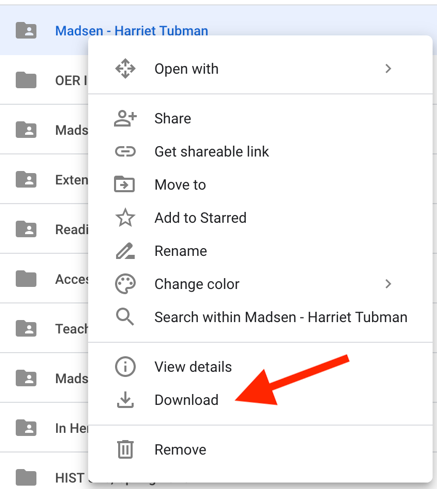
- The file will download as a zipped file. (Note to where on the computer it’s being downloaded so you can find it again.)
- Locate the folder on the computer and unzip it. (Usually this involves double-clicking or right-clicking.)
- Open the folder. Drag your reflection out of it onto your computer desktop.
- Find and open the Upstanders folder in Google Drive.
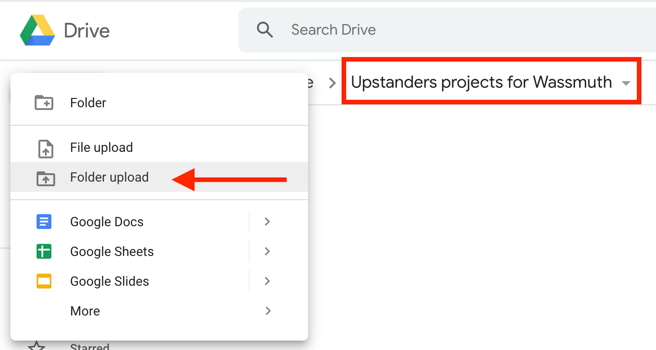
- Upload the unzipped folder into the Upstanders folder. You should be able to just drag and drop it there, but if that doesn’t work, you can click the plus sign at upper left in Google Drive and use this drop-down menu:
Assignment checklist
- Keep an eye out for historical upstanders in course materials and during class activities.
- Claim your upstander in the “Upstander Selection” doc in the course folder in Google Drive.
- Start secondary source research on your upstander.
- Locate primary sources on your upstander. Keep an eye out for openly-licensed images.
- Draft your biographical essay.
- Draft your justification essay.
- Sign up for a presentation date in the “Presentation Sign-Up” sheet in the course folder in Google Drive.
- Double-check to be sure all sources are appropriately cited. Use the Chicago Manual of Style citation format.
- Include “CC-BY” or the phrase “published under a Creative Commons attribution license” at the bottom of your biographical essay and your justification essay.
- Prepare your presentation. Send Dr. Madsen any visuals, a PowerPoint slide deck, or a Google slide deck if you want to use it.
- Double-check to be sure all your images are appropriately licensed.
- Be sure your images are in one of these three formats: .jpg, .tiff, .png.
- Change the names of your image files so that they are descriptive.
- Create a list of your image titles, then provide citations for each item on the list.
- Ask a trusted classmate or friend to read and provide constructive feedback on your biographical and justification essays. Revise your essays accordingly.
- Write your reflection essay and get a friend’s feedback on it. Revise it.
- Follow the submission instructions to create an assignment folder within your student folder in Google Drive.
- Follow the rest of the submission instructions to upload the relevant portions of your work to your new assignment folder and to the Upstanders folder.