• Skip to primary navigation
  • Skip to main content

History 111

Fall 2019

  • Syllabus
  • Course schedule
  • Assignments
  • Resources

Material from class sessions

Fugitive Slave Ads and “Last Seen” ads

by Leslie Madsen · Dec 10, 2019

1. Visit the Freedom on the Move website.

  • Click on “Search.”
  • Use a Gmail (your Boise State account should work) or Facebook account to log in and view the ads, or set up an account.
  • Use the worksheet to analyze those ads.

2. Browse the ads on the “Last Seen” archive.

  • Select three ads that are of particular interest.
  • Use the worksheet to analyze those ads.

You can download the worksheet (.docx).

3. Answer these questions:

  • Based on the text of chapters 14 and 15 and the primary sources accompanying those chapters, how did the lives of enslaved peoples change during the Civil War and Reconstruction?
  • To what extent do the ads capture or hint at these changes?
  • What do we learn from reading the ads alongside the American Yawp‘s primary sources that we might miss if we had read only one set of documents?
  • If you were writing a book about this era, what additional kinds of primary sources would you seek, and why?
Filed Under: Material from class sessions

Sectionalism handouts

Sectionalism handouts

by Leslie Madsen · Dec 3, 2019

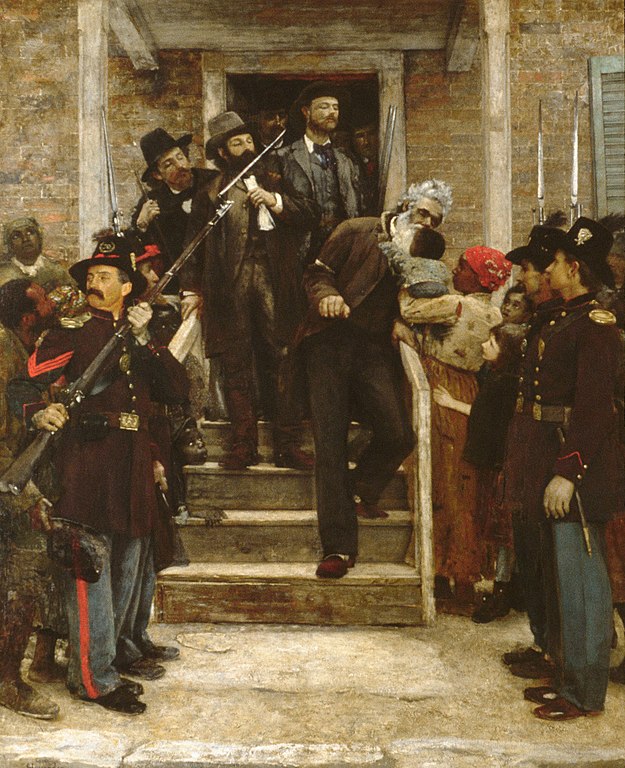
Painting "The Last Moments of John Brown," which depicts John Brown kissing an African-American baby as he descends the steps from the jail on his way to the scaffold
Thomas Hovenden, The Last Moments of John Brown (circa 1882-1884). Metropolitan Museum of Art, via Wikimedia Foundation.

Sectionalism timeline/activity (.docx)

Primary source document analysis worksheet (.docx) (version with current events question)

Filed Under: Material from class sessions

Resources for Chapter 12

Resources for Chapter 12

by Leslie Madsen · Nov 21, 2019

Artifact analysis worksheet (.docx)

Comparing/synthesizing artworks questions (.docx)

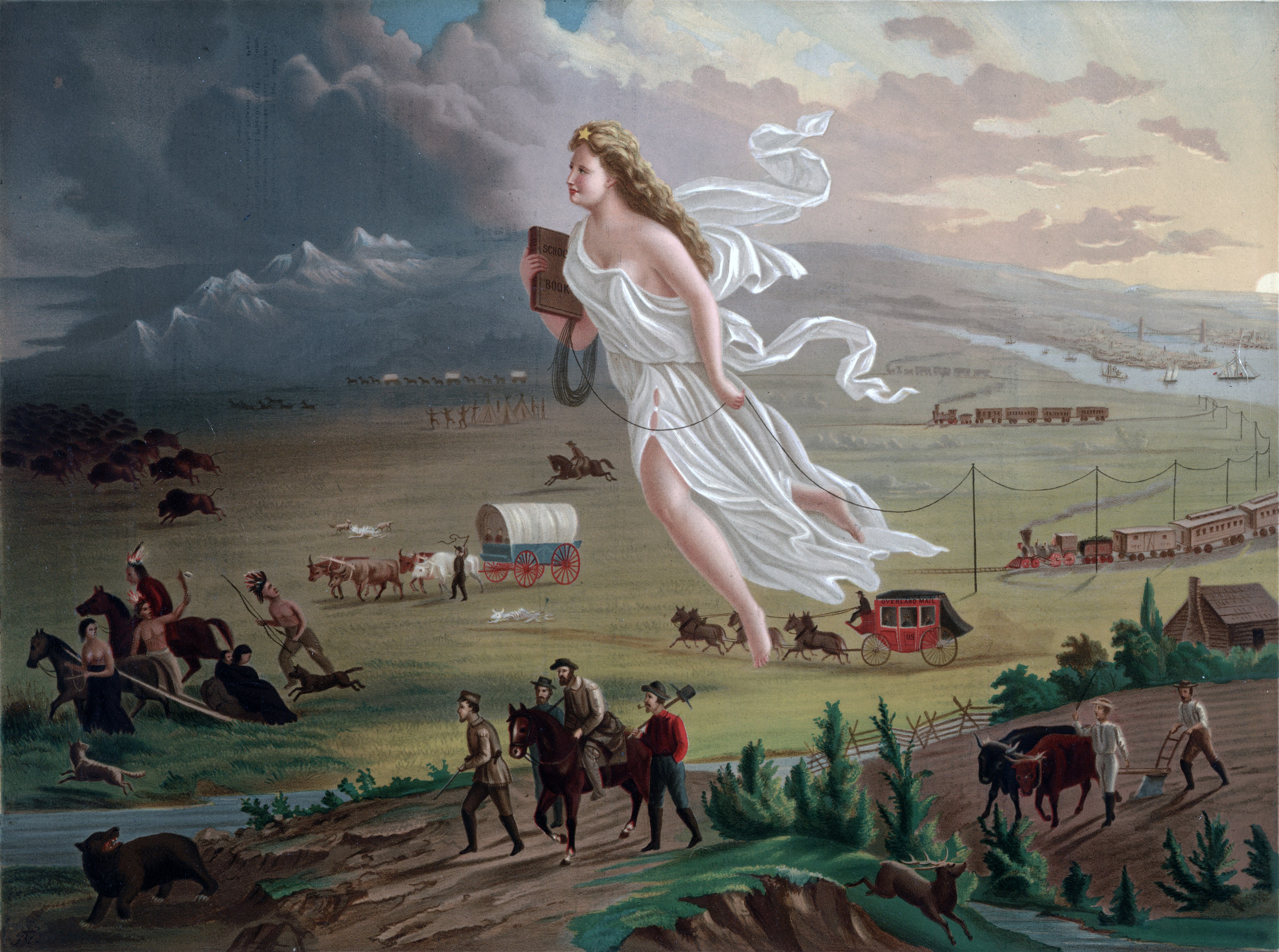
John Gast's American Progress. A woman in flowing gowns hovers over the plains, guiding Native peoples, pioneers, farmers, and trains as she strings telegraph wire.
John Gast, American Progress (1872). Autry National Center, via Wikimedia Commons.
In this painting, various migrants head west across a rocky, mountainous, and forested North American landscape.
Emanuel Leutze, Westward the Course of Empire Takes Its Way (1862). Architect of the Capitol, via Flickr.
This painting depicts General George Washington in a crowded rowboat crossing an icy river. He is standing, and an American flag flies behind him.
Emanuel Leutze, Washington Crossing the Delaware (1851). Metropolitan Museum of Art, via Wikipedia.
Rustic campsite on the edge of a lake or river. Rowboat with two small figures in the foreground.
Robert S. Duncanson, Landscape with Campsite (n.d., but mid-19th century, as Duncanson died in 1872). Smithsonian American Art Museum.

Filed Under: Material from class sessions

Resources for chapters 8 & 9

Resources for chapters 8 & 9

by Leslie Madsen · Nov 14, 2019

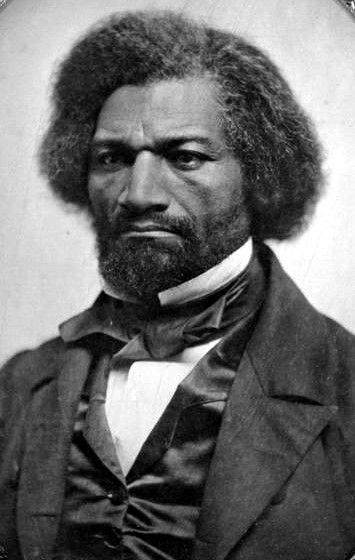
Photographic portrait of Frederick Douglass, circa 1855, when he was about 38 years old
Photographic portrait of Frederick Douglass, circa 1855, when he was about 38 years old. National Portrait Gallery, via Wikipedia.

List of terms for mind-mapping exercise (.docx)

Chapter 9 primary source discussion questions (.docx)

Filed Under: Material from class sessions

Jefferson-Hemings resources

Jefferson-Hemings resources

by Leslie Madsen · Nov 5, 2019

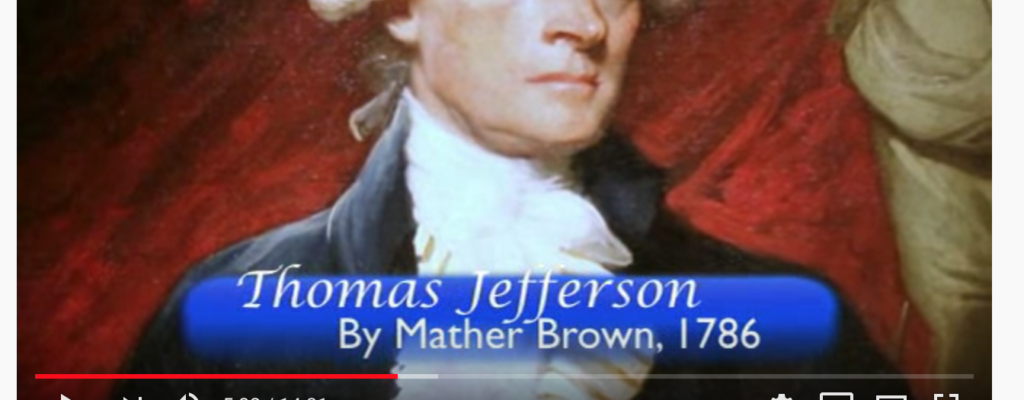
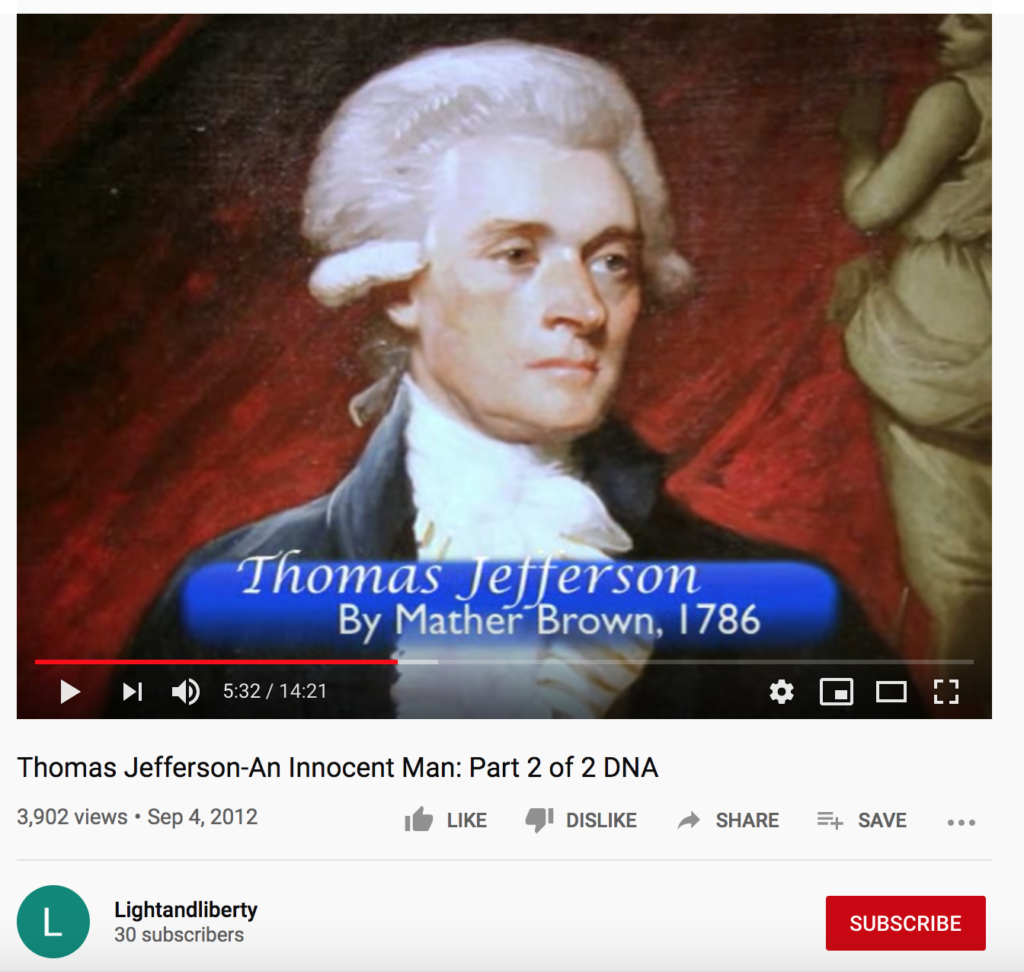
A screen shot of a video claiming Jefferson is "innocent" of having a relationship with Sally Hemings.
A screen shot of a video claiming Jefferson is “innocent” of having a relationship with Sally Hemings.

Activity #1: Look at the evidence and its interpretation by scientists and historians.

Group 1

  1. Read Jefferson fathered slave’s last child: the DNA study published in Nature.
  2. Draw (on a whiteboard) a chart explaining the family tree and the findings. (Yes, we know this isn’t easy. Do your best.)
  3. Do you as a group find the DNA study convincing? Why or why not?
  4. Which is more persuasive to you—the kinds of historical and cultural evidence presented by Walker and other historians, or the scientific evidence? Why?
  5. What does Walker’s book have to say about the persuasiveness of the DNA evidence?

Group 2

  1. Read the Report of the Research Committee – focus on sections III, IV, and V.
  2. Summarize the findings in bullets on a whiteboard.
  3. Do you find the Research Committee’s findings persuasive? Why or why not?
  4. Which is more persuasive to you—the kinds of historical and cultural evidence presented by Walker and other historians, or the scientific evidence? Why?
  5. In what ways does this report align with Walker’s arguments in his book?

Group 3

  1. Read Minority Report on the DNA findings.
  2. Summarize the findings in bullets on a whiteboard.
  3. Do you find the Minority Report’s findings persuasive?
  4. Which is more persuasive to you—the kinds of historical and cultural evidence presented by Walker and other historians, or the scientific evidence? Why?
  5. Clarence Walker refutes the counter-arguments presented by historians in the Minority Report and elsewhere. What kinds of evidence does he use in his rebuttals? Is his persuasive?

Activity #2: Large-group discussion of the various sources

  • What surprised you?
  • If you are undecided, what additional information would you need to come to a conclusion?
  • What kinds of sources would change your mind to come to a different conclusion?
  • Did looking at these other sources change your perception of Walker’s book? If so, why and how? If not, why not?

Activity #3: Reflection (if time permits)

  1. What did you learn today about how historians think and do their work?
  2. What do you still want to learn? Where would you look to find that information?

Filed Under: Material from class sessions

Creative Commons and finding openly licensed images

Creative Commons and finding openly licensed images

by Leslie Madsen · Oct 29, 2019

Because they may be used by the Wassmuth Center in posters at the Idaho Anne Frank Human Rights Memorial, it’s very important that the images you include with your Upstander biography be free of traditional copyright.

Fortunately, it’s fairly simple to find images that are “openly licensed”—meaning they aren’t under traditional copyright. But first, let’s take a look at categories of copyright:

Copyright and the Public Domain

In the U.S., under copyright law, works are either copyrighted or not. If they are not copyrighted, they are considered to be in “the public domain,” and you can use them in any way you wish.

Stanford University offers a good guide with more details on determining whether a work is in the public domain, but here’s the vast majority of what you need to know:

  • Works published in the U.S. before 1924: In the public domain.
  • Works published in the U.S. after 1923 but before 1964: Initially copyrighted for 28 years. If not renewed during the 28th year, the work falls into the public domain. (
  • Works published in the U.S. after 1923 but before March 1, 1989: Generally, if a work was published without copyright notice under the authorization of the copyright owner and the law does not provide an exception for the omission, the work is in the public domain. This category is a bit of a legal minefield, so I encourage you to simply find images published before 1924.

Creative Commons

Creative Commons is a way for intellectual property owners (the creators of works that would normally be under copyright) to provide more flexible licensing of their work. There are several versions of Creative Commons licenses. You can read more about them at the Creative Commons website.

Finding openly licensed images

There are many places to find images that are in the public domain or that are licensed under Creative Commons. Here are my favorites:

The Library of Congress

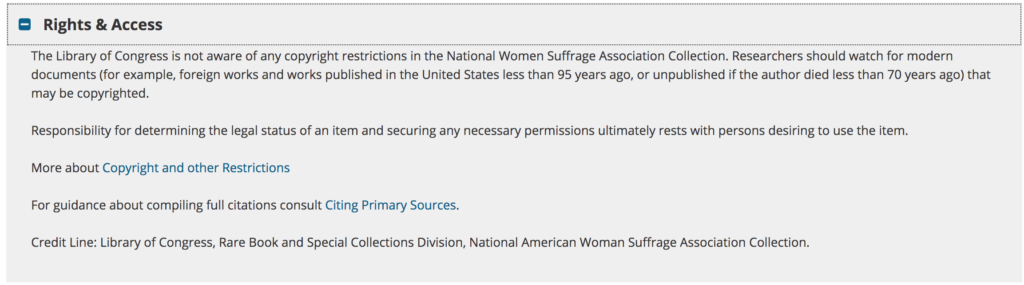
Each digitized item in the Library of Congress’s database has rights and access information. Here’s an example from a photo of Harriet Tubman:

Rights and access info from a photo of Harriet Tubman. The text begins "The Library of Congress is not aware of any copyright restrictions. . ." and then reminds researchers that determining copyright is the researchers' responsibility.

Google image search

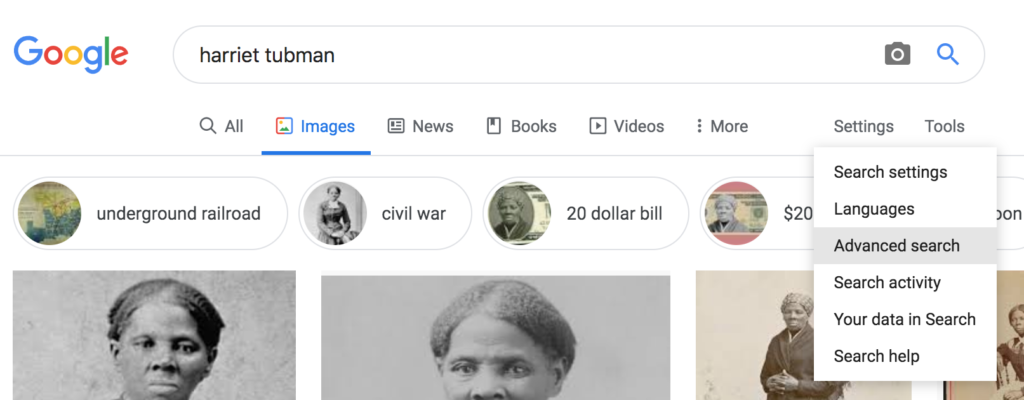
Google lets you sort images by license. Here’s how:

1. Enter a search term into the search box and hit “enter” or “return” on your keyboard.

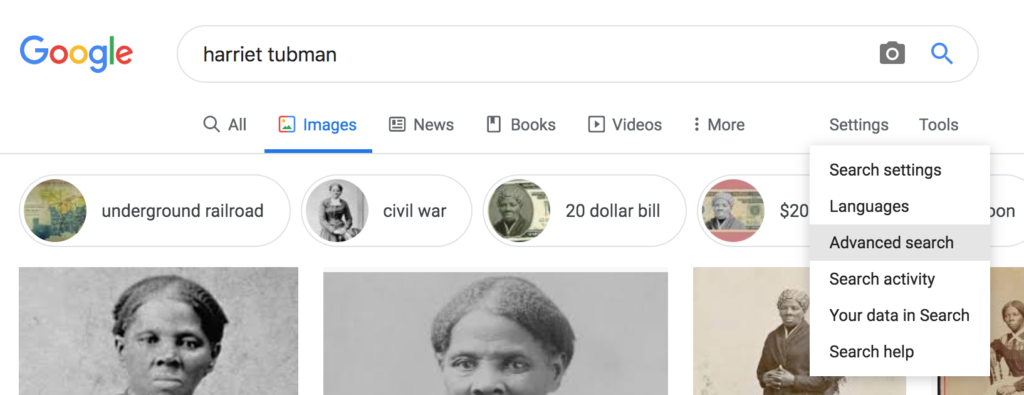
2. On the results page, hover over “Settings” just below the search bar. Select “Advanced search” from the drop-down menu:

Google image search results page with Settings drop-down menu highlighting "Advanced search."

3. Scroll down to the bottom of the Advanced Image Search page. In the drop-down menu next to “usage rights,” select “free to use or share.” Then

4. Click the blue “Advanced Search” button at the bottom of the page.

Be sure to double-check the licensing of your image by reading the terms for the website on which it appears. Sometimes Google picks up images that aren’t actually openly licensed.

Creative Commons image search

Creative Commons provides its own image search engine. Use the drop-down menus on the search results page to refine your results.

Flickr

Flickr is a photo-sharing site. Many museums and archives will share images from their collections there. You can also find current photos of historic sites related to your upstander.

1. Simply type a search term into the search bar on the Flickr home page.

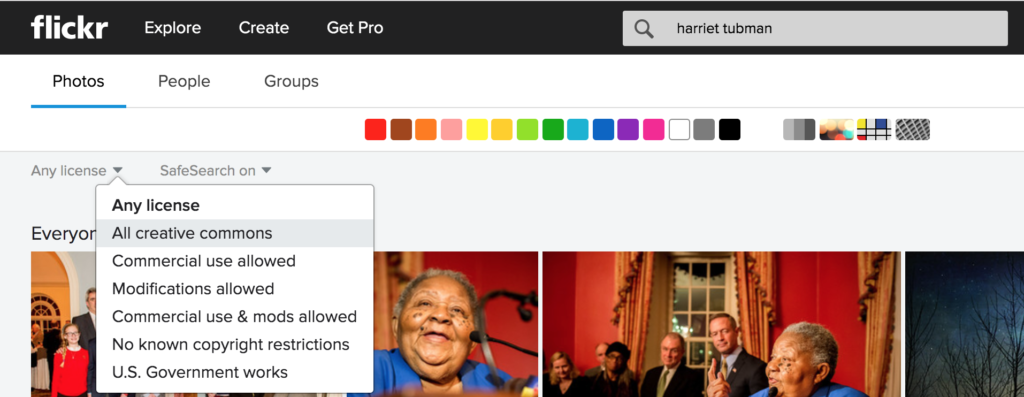
2. Open the drop-down menu for “Any license.”

3. Select either “All creative commons” or other appropriate license that indicates images in the public domain (e.g., “No known copyright restrictions” or “U.S. Government works”):

Flickr search results page. The "Any license" drop-down menu is open.

Filed Under: Material from class sessions, Resources

Material culture

Material culture

by Leslie Madsen · Oct 17, 2019

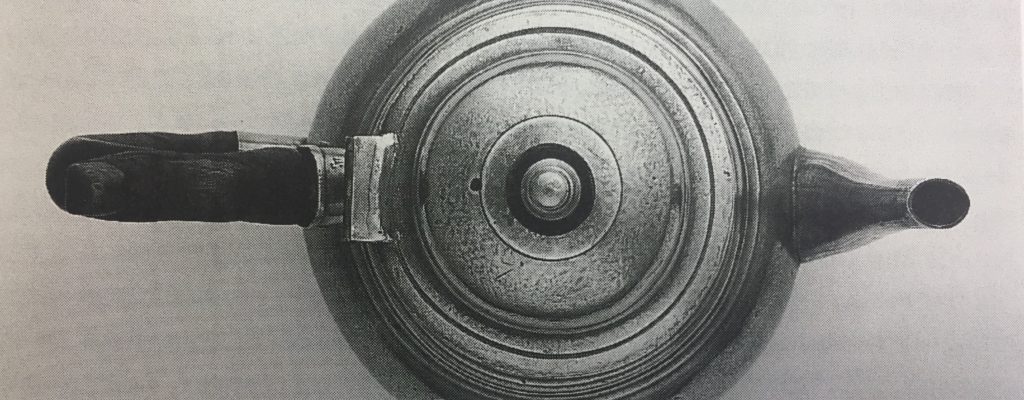
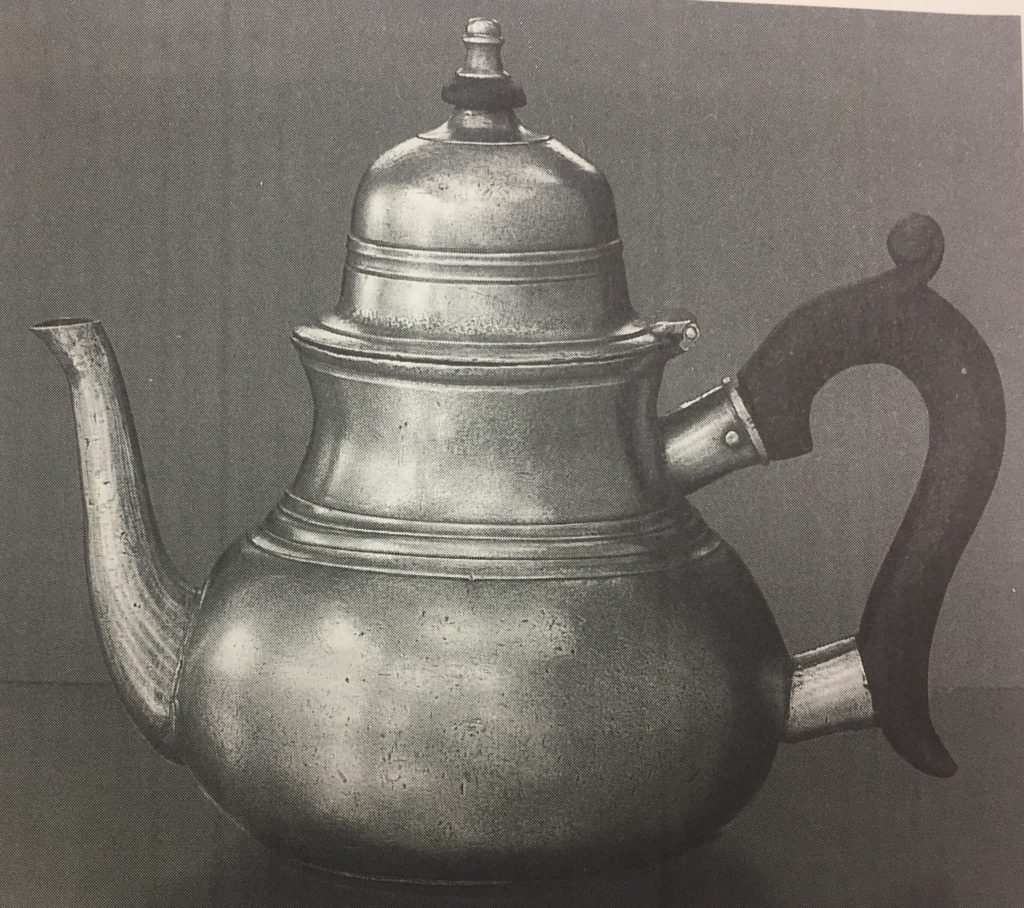
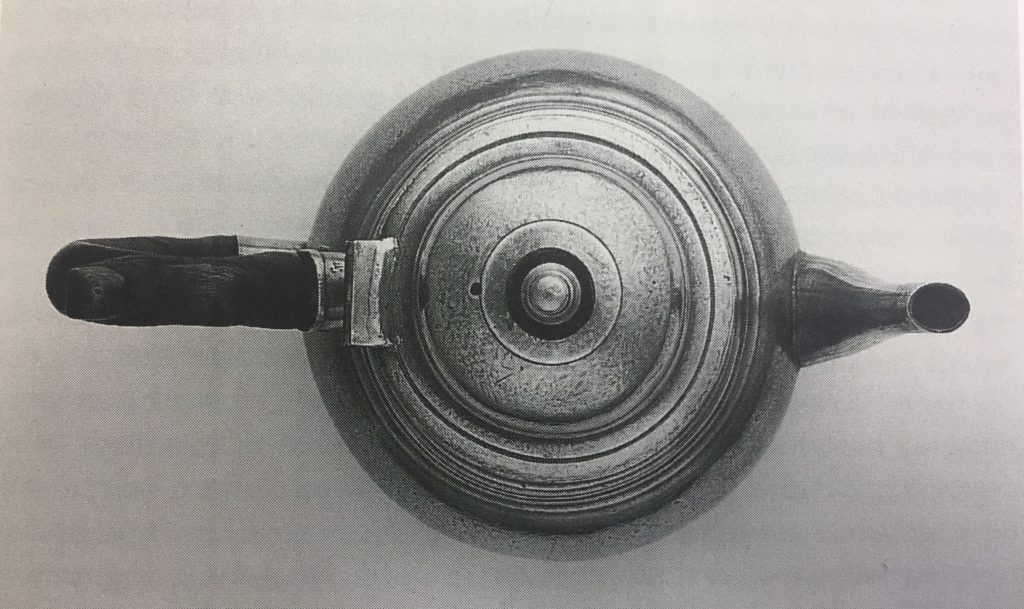
A small pewter teapot seen from the side
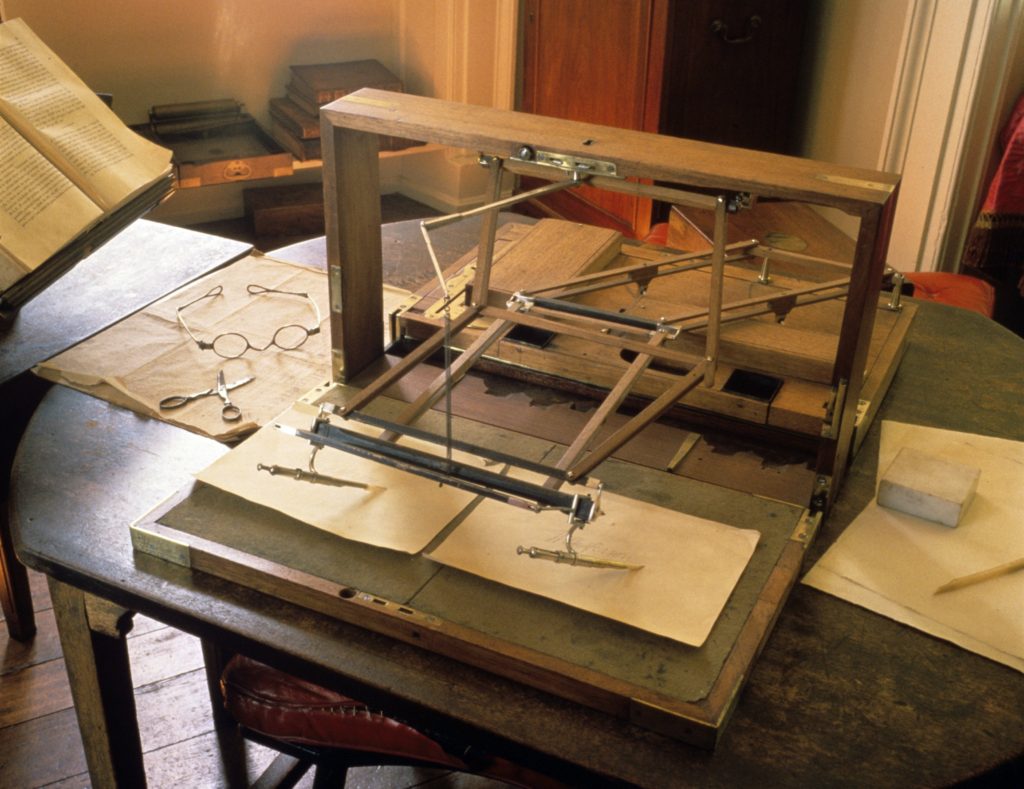
An early nineteenth-century device used to copy letters

Racist stereotypes

Jim Crow Museum of Racist Memorabilia

Content note: The image galleries below contain racist depictions of African Americans. You may find them deeply disturbing or upsetting.

  • Coon stereotype gallery
  • Golliwog stereotype gallery
  • Picaninny stereotype gallery
  • Mammy stereotype gallery
  • Jezebel stereotype gallery
  • Brute stereotype gallery
  • Tom stereotype gallery
  • N*gger and caricature gallery
  • Sapphire caricature

“Post Falls Company Under Fire for Racist Stereotypes”

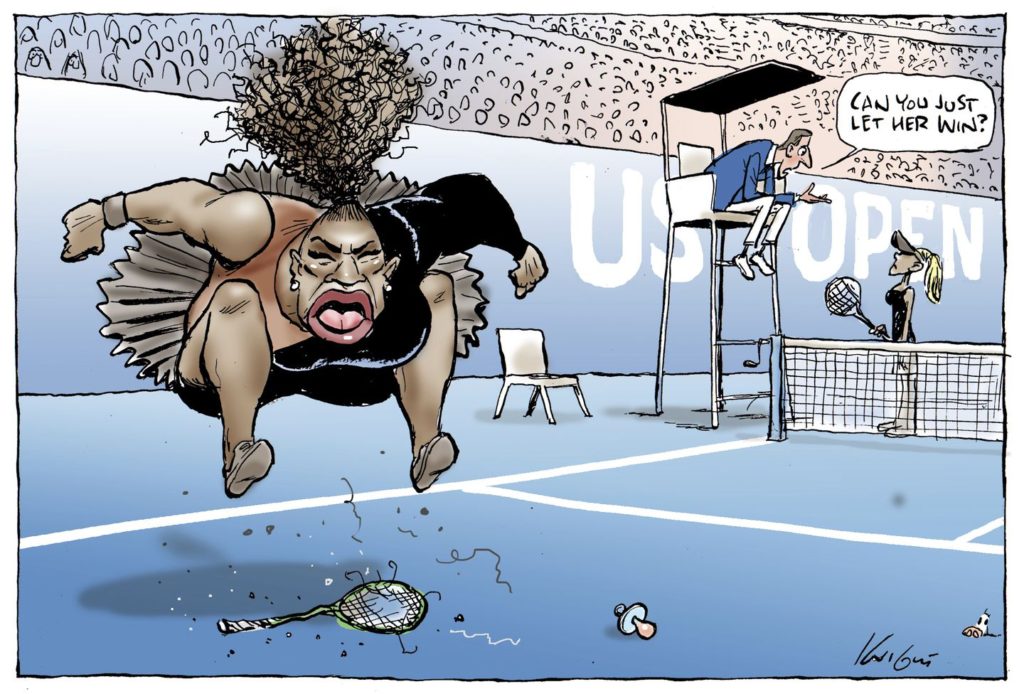
Unflattering cartoon by Mark Knight of Serena Williams stomping on her tennis racket
Cartoon by Mark Knight, 2018

Additional resources

Jules Prown’s method of material culture analysis

Virtual tour of Jim Crow Museum of Racist Memorabilia

David Pilgrim, “Why I Collect Racist Objects”

Brooke Newman, “The long history behind the racist attacks on Serena Williams”

Filed Under: Material from class sessions

Next Page »

Copyright © 2026 · No Sidebar Pro on Genesis Framework · WordPress · Log in